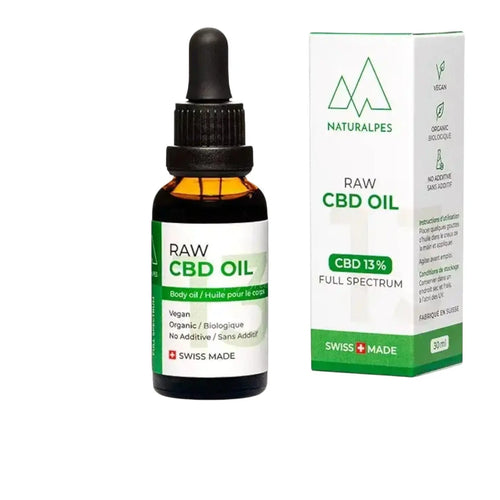


A customer came back to see us after three weeks on a 10% oil, a bit dejected. "I don't feel anything at all – I think CBD doesn't work on me." It's something we hear regularly, and in most cases the problem is neither the product nor the person. It's how the oil is taken.
The problem is the stomach
When you swallow the oil straight away, like a spoonful of syrup, it goes through the digestive system and much of the CBD is broken down by the liver before it even reaches the blood. Available studies put oral bioavailability between 5 and 10%, averaging around 8%. In practice, out of ten drops swallowed, the equivalent of just one ends up circulating in the body.
The sublingual route changes everything. By holding the oil under your tongue for thirty to sixty seconds before swallowing, CBD passes directly into the bloodstream through the mucous membranes, without going through the liver. The effect generally comes within 15 to 60 minutes, compared with longer and far more diluted when you swallow straight away. It seems a minor detail but it completely changes the result you feel.
The dose: almost always too low
The second classic mistake is a dose too low to notice. Many beginners take two drops of a 5% oil, an amount that often stays below the point where an effect becomes clearly noticeable. The habit we encourage is to increase gradually over several days rather than staying stuck on a starting dose that does nothing, watching at each step whether anything changes.
Not all oils are absorbed the same way
The carrier oil matters too. MCT oil, extracted from coconut, is absorbed faster by the body than olive or hemp oil, which can improve how much CBD is actually available. So two oils with the same percentage on the label can give different results depending on their base.
"What we try to explain in the shop is that the percentage on the label only tells part of the story," says Cyril Piaget, founder of Tiny Green. "How you take it matters as much as what's in the bottle."
Everyone's body reacts differently
Finally, liver function, digestion and whether you've eaten fats when you take it also affect absorption. Taking your oil just after a fatty meal, for example, can slightly change things compared with taking it on an empty stomach. None of this is about willpower or "a body that doesn't respond": they're real, documented physiological variables that explain why two people with the same bottle can feel very different things.
Before concluding that CBD doesn't work, it's worth checking these four points: how long you hold it under your tongue, the real dose, the type of carrier oil, and when you take it relative to meals. In most of the cases we see in the shop, correcting just one of these details makes the difference. Read our guide how to dose your CBD oil.