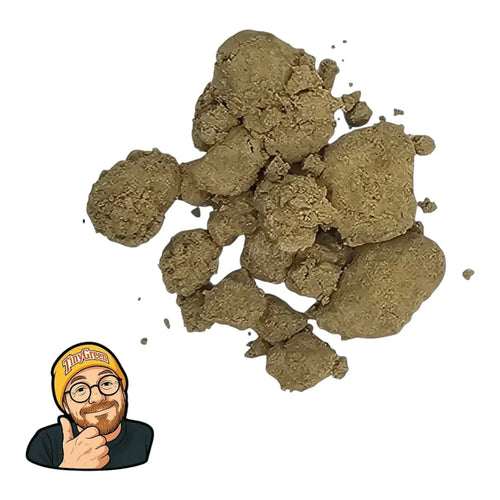
Some questions are asked loudly, almost proudly, and others are whispered with a glance at the door to check nobody's coming in. After years running this shop, I've come to understand that the most awkward questions are often the most useful to answer honestly. Here are a few of them, just as they really come.
"Am I going to get high?"
I hear this one almost every day, often asked quietly by someone who barely dares to say it. The answer is no, and I always insist on it. CBD doesn't activate the same brain receptors as THC. It acts on the 5-HT1A serotonin receptor rather than the dopamine reward circuit, which explains why you can feel relaxed without ever feeling "high". Our flowers contain less than 1% THC, the Swiss legal limit – far too low to produce a noticeable psychoactive effect.
"Is it like smoking a joint?"
No, and this confusion mostly comes from appearance: a CBD flower looks a lot like a regular cannabis flower, same smell, same texture. But chemically, they're two products with different effects. Smoking CBD is still combustion, though, with the same unwanted substances as regular tobacco: carbon monoxide and tar. I say it clearly to every customer hesitating between flower and oil: if the idea is to avoid inhaling smoke, it's better to go for an oil or a vape.
"Could it show up positive in a roadside test?"
I'm mostly asked this after a weekend when someone smoked flower. The honest answer: it's possible, even with a perfectly legal product. A roadside saliva test detects the presence of THC, not its exact level, and a CBD flower always contains a trace of THC, however tiny. After smoking, that trace can be detected for four to six hours. The Swiss limit of 1.5 micrograms of THC per litre of blood exists for this, but a positive test can trigger complicated checks even if you're below it. My personal rule: I never drive in the hours after smoking flower, and I advise my customers to be just as careful.
A customer once asked me, almost embarrassed: "You won't judge me if I tell you I've been taking it to help me unwind in the evening since my husband left?" I told her half my customers had a story behind their first purchase, and that I wasn't there to judge – just to give good advice.
"Can my teenager buy it on their own?"
A frequent question from parents, and the answer isn't as simple as it seems. Since 1 October 2024, the federal Tobacco Products Act classes CBD flowers and vapes as products treated like tobacco: sale to under-18s is banned, with mandatory age checks. For oil or capsules, the situation is less clear-cut since they fall under food law, with no explicit federal minimum age. In my shop, I've chosen to set 18 as the rule for all products, without exception, even where the law would allow some leeway.
"Will it make me addicted?"
This one often comes from customers who've already had a complicated relationship with a substance – tobacco, alcohol or something else. The World Health Organization report published in 2017 is clear on this point: CBD shows no identified potential for dependence or abuse, and doesn't activate the brain's reward circuit involved in addiction. I always add that this doesn't mean the product is trivial or should be used without thought, but the fear of physical dependence has no serious scientific basis for CBD on its own.
Why I prefer these questions to silence
What I've learned over time is that these awkward questions are a sign of trust, not shame. People who ask them want an honest answer, not a sales pitch. I'd much rather spend ten minutes explaining a legal or physiological nuance than let someone leave with a wrong idea. That's also what running a small shop in Yverdon is about: taking the time that big stores and websites never take.