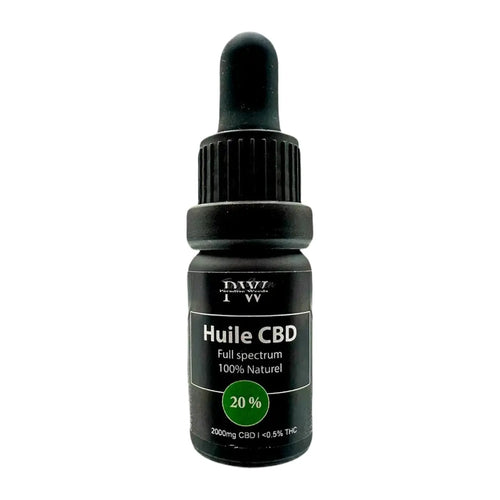

A customer has been picking up his bottle of oil every three weeks for almost a year, like clockwork. One day he asked the question himself, before I had time to: "Am I getting hooked on this stuff?" Good question. We asked several regular customers directly, and looked at what science really says behind it.
What the World Health Organization says
In 2017, the WHO published an official report on CBD concluding that no study had been able to show any potential for abuse or dependence linked to this molecule. It's not an opinion – it's the conclusion of a scientific review by the reference body for public health. CBD isn't on any list of risky substances, unlike THC or nicotine.
Why the mechanism is different
Dependence, in the biological sense, almost always involves the brain's reward circuit and a release of dopamine that drives you to repeat the behaviour. That's the mechanism that makes nicotine, alcohol or opioids addictive. CBD doesn't activate this circuit. There's no dopamine spike associated with taking it, which largely explains why it causes neither tolerance (needing to increase doses to feel the same effect) nor withdrawal symptoms when you stop.
A habit isn't a dependence
What does exist is a routine. The customer who comes back every three weeks isn't hooked in the medical sense: he's simply built a daily dose into his rhythm of life, a bit like having a coffee in the morning without being biologically dependent on it. The difference between habit and addiction is precisely the absence of compulsion and escalating doses.
"This customer asked me the question frankly, and I answered him frankly," says Cyril Piaget, founder of Tiny Green. "If he stopped tomorrow, he'd have no withdrawal symptoms. What he might get back is less restful sleep. But that's the problem he was dealing with in the first place, not a dependence on the product."
CBD and other dependences
One point that often surprises people: several studies are actually exploring CBD's potential to help reduce other forms of dependence, notably on tobacco and opioids. The results remain preliminary, but the direction is the opposite of the common belief: rather than a gateway to addiction, CBD is being studied as a possible tool for getting out of it.
So the question isn't meaningless – it deserves to be asked frankly rather than avoided out of embarrassment. But the answer, based on what research shows to date, remains clear: taking CBD every day isn't a dependence. It's a habit like any other, without the biological mechanisms that make a substance truly addictive.