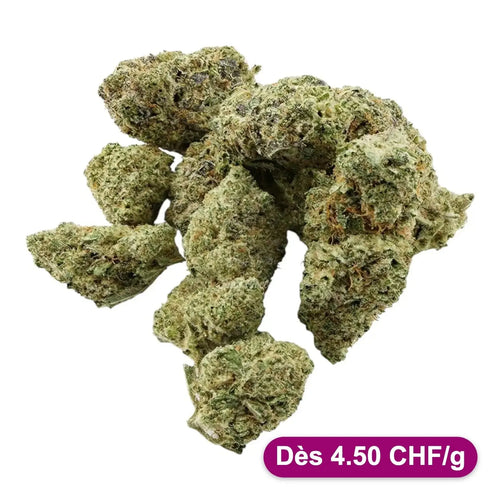
A customer asked me why I put so much emphasis on the Swiss origin of our flowers, wondering if it wasn't just another marketing argument. The question deserves a real answer, because there is a real difference – but not necessarily the one you'd imagine.
The first real gap: the permitted THC limit
Switzerland allows total THC content up to 1%, compared with 0.3% in the European Union. It's not just an administrative number: it means Swiss growers can legally cultivate hemp varieties richer in cannabinoids overall, often with more concentrated CBD profiles, without leaving the legal framework. A product imported from a European country bound by the 0.3% limit starts with a different genetic and agricultural constraint from the outset.
Growing conditions in the mountains
Some Swiss hemp is grown at altitude, in regions where generous sunshine and big day–night temperature differences favour richer terpene profiles. Plants grown in the mountains often naturally develop higher cannabinoid concentrations, as a response to their environment. It's neither systematic nor guaranteed for all Swiss crops, but it's a real advantage where it applies.
"Swiss CBD" alone guarantees nothing
Here's the important point not to overlook: simply writing "Swiss CBD" on packaging doesn't guarantee at all that the hemp was grown in Switzerland. Some brands import their raw material from elsewhere in Europe and only process or package the product in Switzerland, while keeping the label. The claim alone is worthless without proof behind it.
What really counts: traceability
What sets a genuine Swiss product apart from one that just uses the label is the seller's ability to show you where the flower really comes from: which farm, which region, with which certificate of analysis (COA) for that exact batch. A good Swiss COA shows the real THC content and the absence of heavy metals, pesticides and mould, carried out by an independent lab that goes beyond the legal minimum. That's the real guarantee – not the flag on the label.
And what about price?
Swiss hemp generally costs more to produce, between local labour costs and some growers' stricter quality requirements. A product imported from Spain or the Czech Republic can be perfectly honest and well controlled, simply cheaper to produce, which is reflected in the final price. It doesn't automatically mean lower quality, but it explains much of the price gap you see on the shelf.
"I thought 'Swiss' was just another argument to justify a higher price. Since Cyril showed me the COA with the farm's name on it, I understand better what I'm paying extra for." – a customer of the shop
My straight advice
Never trust the word "Swiss" alone on a label. Ask for the batch COA and, if possible, the exact origin of the crop. A well-controlled European import is worth as much as a poorly traced Swiss CBD, and vice versa. The real difference isn't about the flag – it's about the transparency of whoever sells it to you. All our flowers are made from 100% Swiss hemp.